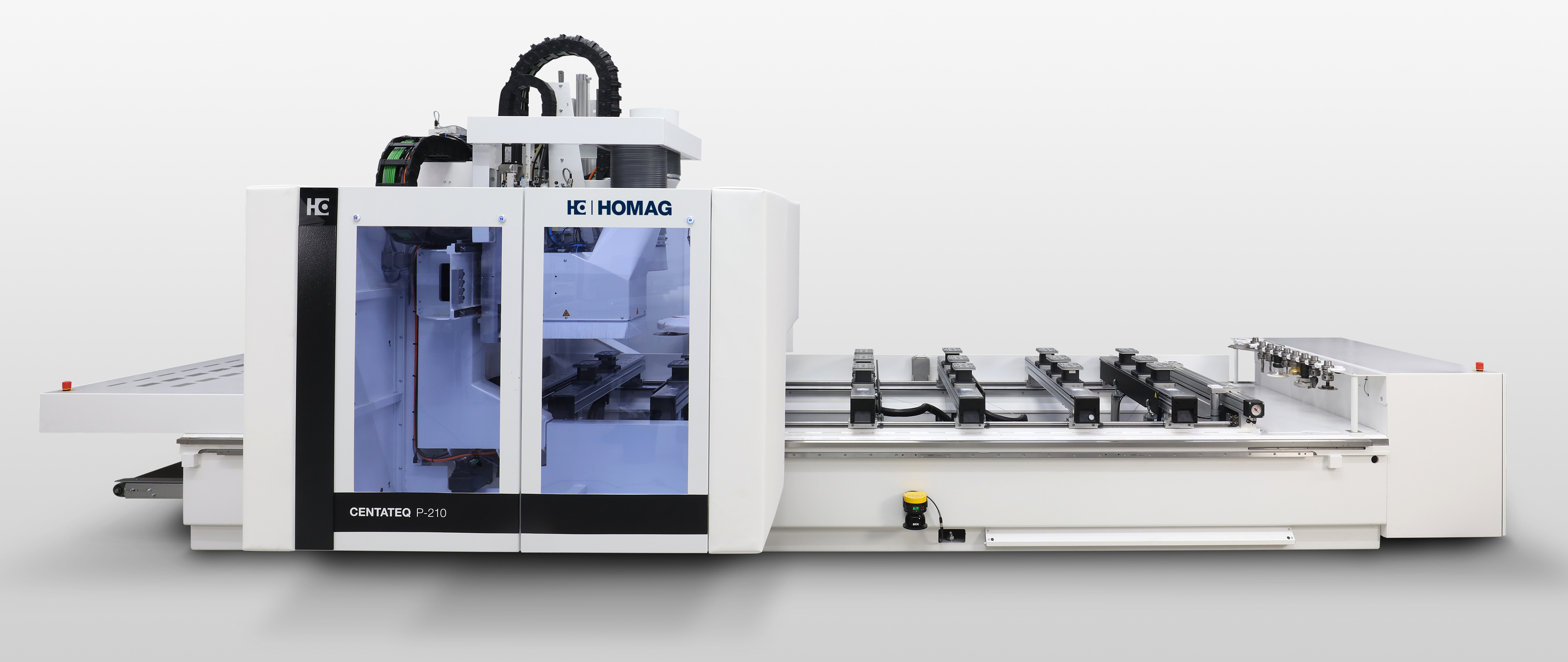
CENTATEQ P-210
Advanced CNC machining center with configurable 3-, 4-, and 5-axis spindle technology. Designed for versatile woodworking applications with integrated edge banding and drilling capabilities.
The CENTATEQ P-210 is a configurable CNC machining center engineered for high-precision woodworking production environments requiring flexibility across multiple machining tasks. Built on a rigid machine stand with dual-driven moving gantry, it delivers consistent accuracy for complex 3D part geometries while maintaining structural stability during high-load operations. The machine serves as a central hub for multi-process workflows in mid-to-large woodworking facilities. Core technical differentiation lies in its freely configurable spindle architecture, available in 3-, 4-, or 5-axis configurations to match specific production requirements and part complexity. The system accommodates up to 3 independent tool changing systems with a combined capacity of 24 tool slots (14-slot primary magazine plus 10 additional slots), enabling extended production runs without manual tool restocking. Control is managed through the powerTouch2 PC87 system, providing intuitive programming and real-time machine optimization. The 300 mm maximum saw blade diameter supports primary processing operations including edge banding and drilling integrated directly into the machining workflow, eliminating secondary handling. The P-210 is positioned for medium-to-industrial workshops (5-50+ employees) executing production volumes of 50-500+ parts monthly across solid wood, engineered panels, and composite materials. It excels in job-shop environments requiring rapid changeover between custom furniture components, cabinet sides, drawer fronts, and architectural millwork. The machine targets operations that have outgrown single-spindle routers but require greater flexibility than dedicated single-purpose equipment. Within its machining center class, the CENTATEQ P-210 balances configurability with operational simplicity—the multi-system tool changer reduces cycle times in mixed-part production scenarios compared to sequential tool changes on simpler machines, while the modular spindle approach avoids capital expense of purchasing separate 3-axis, 4-axis, and 5-axis machines.